
Flat staking vs percentage staking: which bankroll method survives a losing streak
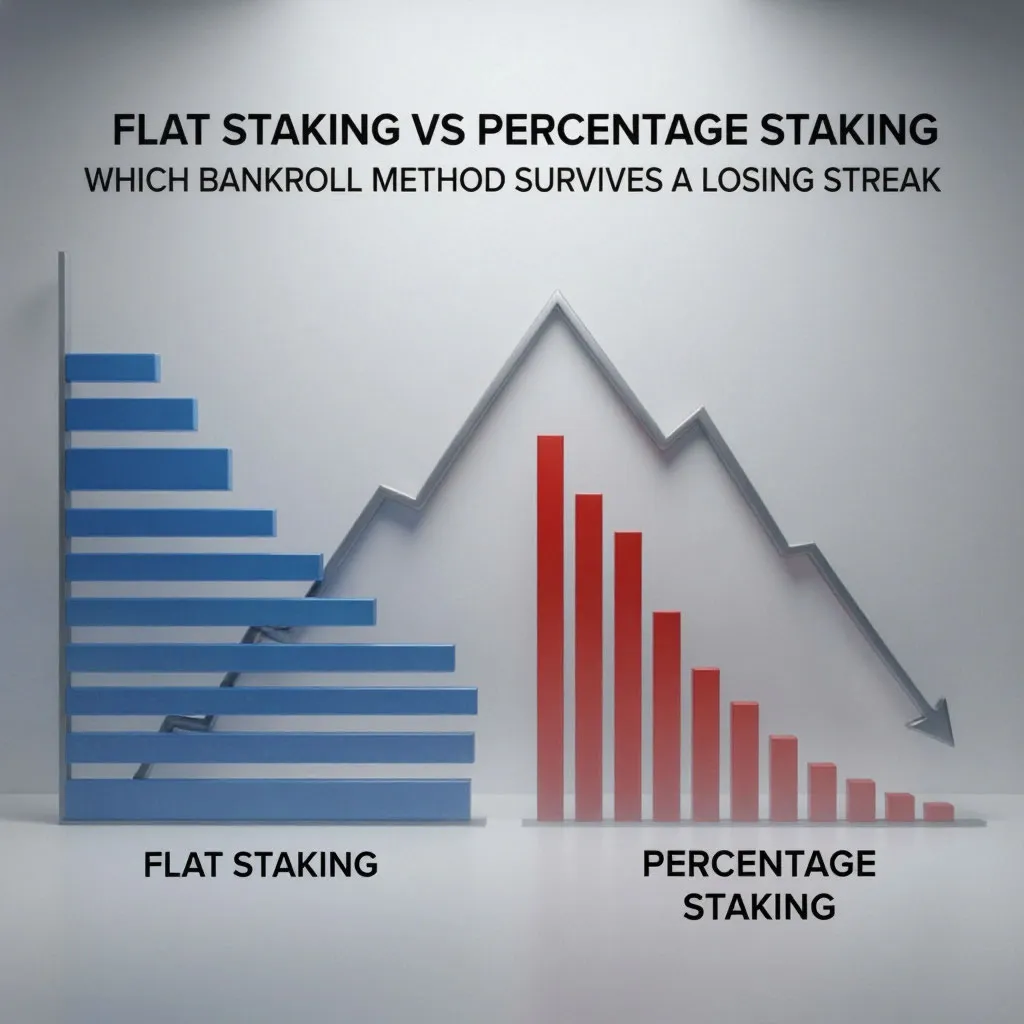
Every bettor eventually meets the same enemy: the losing streak. It does not announce itself, it simply arrives — five bets in a row miss, then six, and your account balance starts to look fragile. The staking method you chose weeks ago suddenly becomes the most important decision in your betting life. That is why the debate between flat staking and percentage staking matters so much: both are simple, both are disciplined, but they behave very differently when luck turns against you.
The short answer is that percentage staking survives losing streaks better, while flat staking grows a bankroll faster and keeps results easier to measure. Neither method is universally superior. The right choice depends on how much variance you can tolerate, how confident you are in your edge, and whether you treat betting as a long-term investment or as entertainment with a budget.
What flat staking actually means
Flat staking is the simplest staking plan in existence. You decide on a fixed unit — say $10 — and every bet gets exactly one unit, regardless of odds, confidence level, or current bankroll size. If you have $1,000 and bet $10 per wager, that stake stays $10 whether your balance grows to $1,400 or shrinks to $700.
The appeal is obvious. Flat staking removes emotion from sizing decisions, makes results easy to analyse, and gives you a clean picture of whether your picks are profitable. If you placed 100 bets at one unit each and finished 15 units up, you know your edge is real. There is no noise from variable stakes distorting the picture.
The weakness hides in the name: the stake is flat, but your bankroll is not. After a brutal losing streak, that fixed $10 bet represents a bigger and bigger slice of what remains. Ten losses in a row might leave you with $900, but those same $10 bets now feel heavier. In extreme cases, a long cold spell can eat a fixed stake plan alive if the starting stake was too aggressive relative to the total bankroll.
What percentage staking actually means
Percentage staking ties every bet to the current size of your bankroll. You choose a fixed share — commonly between 1% and 5% — and multiply it by whatever your balance is right now. With $1,000 at 2%, your first bet is $20. If the bankroll climbs to $1,200, your stake becomes $24. If it drops to $800, the stake shrinks to $16 automatically.
This self-adjusting mechanism is the method’s superpower. Losing streaks automatically reduce your exposure: as the bankroll falls, so does every stake, which slows the bleeding dramatically. Mathematically, a pure percentage plan can never technically go broke, because the stake approaches zero as the balance does. Winning streaks work the same way in reverse — stakes grow as your bankroll grows, which compounds gains naturally.
The trade-off is subtler than most guides admit. Recovering from losses takes longer, because each shrunken stake wins back smaller absolute amounts. Percentage staking also makes performance analysis slightly messier: when every bet has a different stake, raw profit figures say less about your actual picking skill. And there is a psychological sting — after a rough patch, the visible progress of climbing back can feel sluggish.
How each method behaves during a losing streak
Let’s put both methods under stress with a concrete scenario. Imagine a bettor with $1,000, betting at even odds, who loses ten bets in a row — an ugly but entirely realistic stretch for anyone who bets regularly.
With flat staking at $10 per bet, ten losses cost exactly $100, leaving $900. Simple, predictable, easy to explain at the dinner table. The damage is linear: every additional loss removes the same absolute amount. The danger comes later — if the streak extends to twenty or thirty losses, the fixed stake begins to consume a meaningful percentage of what is left, and the cushion that felt comfortable on day one quietly disappears.
With percentage staking at 2% per bet, the math tells a different story. The first loss costs $20. The second costs 2% of the remaining $980 — $19.60. The third costs $19.21, and so on. After ten straight losses, the bankroll sits around $817 rather than $800, and each new loss keeps getting cheaper. The method does not prevent the streak from hurting, but it guarantees the pain decelerates exactly when you are most vulnerable.
This is the core distinction that should drive your decision: flat staking keeps your stakes stable while your risk grows as you lose, and percentage staking keeps your risk stable while your stakes fall as you lose. Both are defensible; they simply optimise different things.
Side-by-side comparison
To see the trade-offs clearly, it helps to line the two systems up against each other across the criteria that actually matter in practice. The overview below summarises how each method performs on the dimensions bettors weigh most often.
| Criteria | Flat staking | Percentage staking |
|---|---|---|
| Stake calculation | Fixed unit, never changes | Fixed share of current bankroll |
| Behaviour during losing streaks | Losses stay constant in absolute terms; relative risk rises | Losses shrink automatically; relative risk stays constant |
| Recovery speed after a slump | Faster in absolute dollars | Slower, because stakes shrink with the bankroll |
| Simplicity | Extremely easy to track | Requires recalculating stakes each time |
| Performance analysis | Clean, comparable unit-based records | Needs ROI or profit-percentage metrics to stay meaningful |
| Ruin protection | Depends heavily on chosen unit size | Structurally very strong; stake approaches zero with the balance |
| Growth during winning runs | Linear, steady | Compounding, accelerates with success |
Reading that breakdown, a pattern emerges. Flat staking is a measurement tool that happens to manage money; percentage staking is a risk-management tool that happens to measure money less cleanly. Your priority — insight or protection — points you toward one or the other.
Choosing the right unit and percentage
Both methods fail for the same reason when applied carelessly: the base number is wrong. A flat stake of $50 against a $1,000 bankroll is a disaster waiting for a streak to happen, no matter how elegant the system sounds. The same goes for percentage staking at 8% or 10% — these numbers survive nothing.
As a starting framework, most experienced bettors work within these boundaries:
- Flat staking: set each unit at 1% to 2% of your starting bankroll, which gives you roughly 50 to 100 betting attempts before a catastrophe becomes mathematically inevitable.
- Percentage staking: keep the stake between 1% and 3% per bet, with 2% being the most common sweet spot for bettors who face meaningful variance.
- Odds sensitivity: the higher the average odds you bet, the deeper you should sit in the conservative end of both ranges, because long losing runs are statistically normal at bigger prices.
- Confidence adjustments: some bettors scale stakes slightly by edge strength, but any deviation from flat or percentage sizing should be small, deliberate, and written down before the bet, not improvised after.
These limits are not superstition — they are the difference between surviving a normal bad month and quitting the hobby entirely. A bankroll divided into fewer than 30 units turns any routine cold spell into an existential event, while 100 units can absorb even a miserable stretch and leave you in business.
Common mistakes that sink both methods
The staking plan is rarely the weakest link; discipline is. Bettors who switch systems mid-slump, chase losses with oversized stakes, or quietly double units after a win defeat even the mathematically perfect plan. Watch for these recurring traps:
- Doubling stakes after losses to “get back to even” — this converts a survivable streak into an unrecoverable one faster than anything else.
- Raising the flat unit or percentage after a winning week, which quietly inflates risk exactly when overconfidence peaks.
- Abandoning percentage staking during recovery because small absolute wins feel too slow, then reverting after the next bad beat.
- Mixing methods without noticing — staking flat for weeks, then switching to percentages after a slump, which makes your records impossible to analyse.
Each of these errors shares a root cause: the staking plan is being used as a mood ring instead of a rule. A method only protects you if you follow it when you least want to.
So which one survives the streak?
If survival is your only criterion, percentage staking wins. Its automatic downscaling means a losing streak hurts but never compounds, and the mathematical structure makes true ruin nearly impossible. Bettors who prize longevity, who bet higher-variance markets, or who know they struggle with discipline under pressure are better served by percentages.
Flat staking survives too, provided the unit is conservative — but it relies on you honouring the fixed size while the numbers around it deteriorate. In exchange, it gives you the cleanest possible read on whether you actually have an edge, which is arguably the most valuable information in betting. Serious bettors who are still testing their strategy often start flat precisely for this reason, then migrate to percentage sizing once their records justify scaling.
A reasonable compromise many experienced bettors land on is a hybrid: flat staking while the bankroll stays within a normal range, and a pre-agreed recalibration point — say, every 25% gain or loss — where the flat unit is reset to match the new balance. This keeps the analytical clarity of flat staking while borrowing some of the streak protection from the percentage model.
Whatever you choose, decide it before the streak arrives, write it down, and let the system do the worrying. The whole point of a staking plan is that your future self, mid-slump and frustrated, does not get a vote.