
What is a void bet? How refunds work when a match is cancelled
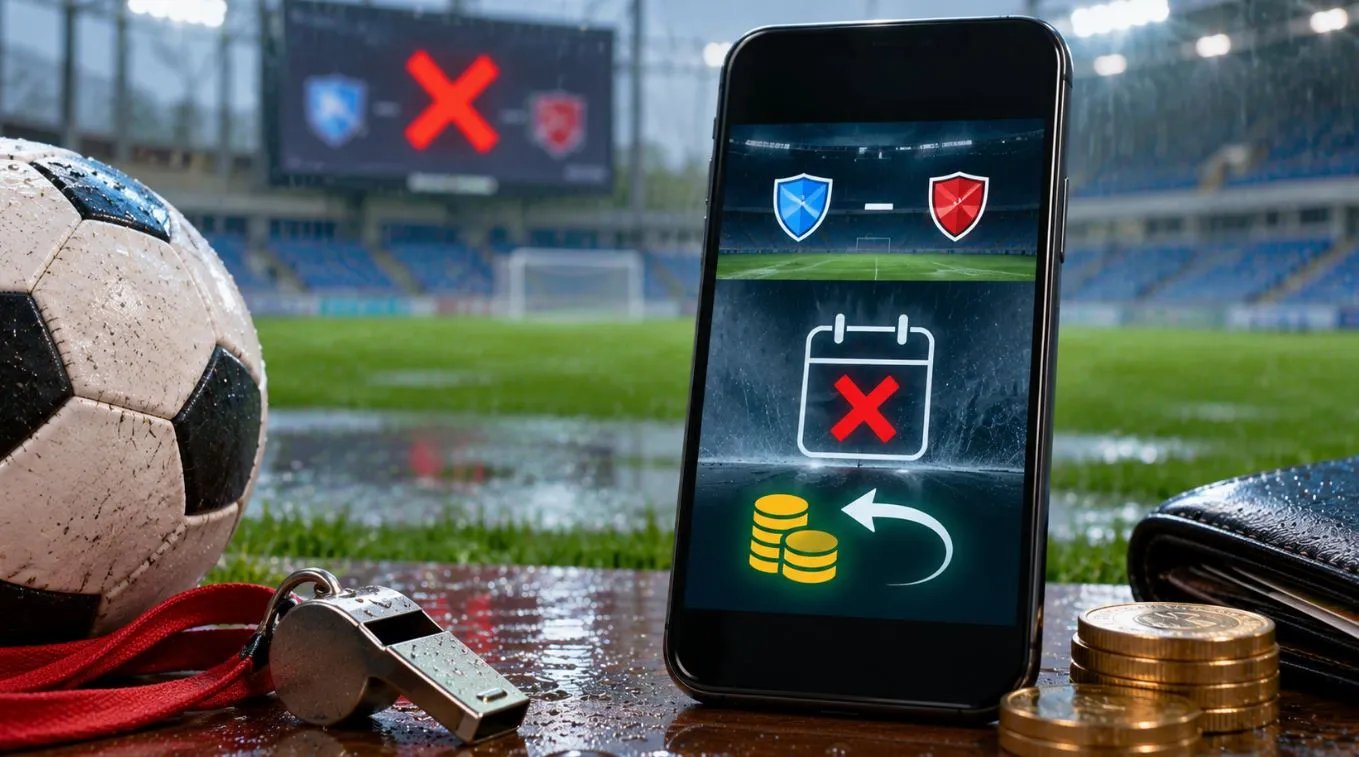
Almost every bettor meets this situation sooner or later: the slip shows a green result, yet no money has arrived. The bet did not win and did not lose — it was voided. Understanding when bookmakers void bets, and exactly how much you get back, saves both money and nerves, because the rules are far less mysterious than they first appear.
What a void bet actually means
A void bet is a wager that the bookmaker removes from settlement as if it never existed. Your stake returns to your balance in full, with no profit and no loss. In betting language this outcome is also called a push, a dead heat or simply “no bet”, and on the slip it usually appears as void, abandoned or stake refunded rather than as a win or a loss.
The logic behind it is simple. A bet is an agreement about a specific event under specific conditions. If those conditions break — the event disappears, the rules change or the offer was wrong — the agreement cannot be honoured on either side, so the stake goes back. Crucially, this applies not only to cancelled matches. Voiding also covers cases where the bet was placed on terms the bookmaker cannot honour: an obvious pricing error, a match played under unexpected rules or a market that simply never got a fair chance to settle.
The situations that turn a bet void
Bookmakers follow settlement rules published in their terms and conditions, and while the wording differs from site to site, the core triggers repeat everywhere. Knowing them in advance helps you predict which of your slips might collapse before the first whistle:
- Postponement or cancellation. The match is called off and not played within the window stated in the bookmaker’s rules, often 48 hours from the original kick-off.
- Abandonment. The game starts but is halted for good — crowd trouble, weather, floodlight failure or security concerns — without being completed within the set timeframe.
- Changes to competition format. A fixture is moved to a neutral venue, switched to a different stadium, played behind closed doors or awarded as a walkover rather than played.
- Market-specific void conditions. Player markets need the named player to start; goalscorer bets are voided if the player never takes the field. Some bookmakers also void first-half bets if the break is not reached, and season-long markets if the competition is not finished.
- Palpable errors. Odds clearly wrong by orders of magnitude — a decimal point in the wrong place — can be voided even after the event.
- Rule and format mismatches. If a bet was offered under rules that later change, or the bookmaker made a genuine mistake in the offer itself.
The common thread in all these cases is fairness in both directions: the bettor did not get the contest they agreed to, and the bookmaker did not either. When that contract breaks, neither side profits.
How the refund is calculated in a single bet
With a single bet, the arithmetic is refreshingly kind. The entire stake returns to your balance, usually within minutes of the event being officially declared void. A £20 back of a postponed fixture means exactly £20 back — not £20 minus fees, not a bonus credit, and not store credit that has to be wagered again.
One detail deserves attention. If you placed the bet using a free bet token or bonus funds, the refund works differently: the token itself comes back, not its cash equivalent. Cash stakes are refunded as cash, bonus stakes as bonus.
How refunds work in accumulators and system bets
Multiple bets are where voiding gets genuinely interesting, because the refund does not simply cancel the whole slip. An accumulator with a void leg is recalculated: the void selection is removed and the odds of the remaining legs are multiplied together, so a four-fold with one voided match at odds of 2.00 effectively becomes a three-fold.
Imagine a £10 four-fold on selections at 2.00, 3.00, 1.50 and 2.50, where the 3.00 leg is voided. Instead of the original potential return of £450.00, the slip now pays as a three-fold of 2.00 × 1.50 × 2.50 = 7.50, returning £75.00 on a win. Your stake stays £10 throughout — it is the odds that shrink, not your money.
System bets behave with the same logic. A patent or a trixie with one void selection simply drops that selection, and the remaining combinations are settled at adjusted odds. If every leg in a system or accumulator is voided, the entire stake returns in full.
A quick overview shows how each bet type settles when part or all of the slip is voided:
| Situation | Single bet | Accumulator | System bet |
|---|---|---|---|
| One match cancelled | Full stake returned | Leg removed, odds recalculated | Selection dropped from combinations |
| Several matches cancelled | Each returns separately | Remaining legs multiplied | Remaining combinations settle |
| All legs voided | Full refund | Entire stake returned | Entire stake returned |
| Player market, player absent | Stake returned | Leg recalculated | Selection dropped |
The practical takeaway is that a void never destroys a slip — it weakens it. Your money is never lost on the voided part, but the potential return shrinks to match the bets that actually ran. Some bettors even plan for this deliberately, backing accumulators where one leg has a genuine cancellation risk and accepting the reduced odds as insurance against the rest of the slip.
Void versus other settlement outcomes
A void bet is easy to confuse with outcomes that look similar but cost money. Knowing the boundary prevents nasty surprises when checking a settled slip:
- Void means the stake returns and the bet is treated as never placed, for example on an abandoned match.
- Dead heat in horse racing or golf means the stake is partially refunded and the return is divided, because two selections share the winning position.
- Push in handicap and totals betting means the line was exactly matched, the stake returns and the bet counts as neither won nor lost.
- Lost bet means the stake is gone, even if the loss felt unfair — an offside goal, a late red card or a missed penalty changes the result but not the settlement.
- Cancelled after a result is different again: if the match reached a result before being abandoned, that result usually stands, and only matches abandoned before a decisive point are voided.
The differences matter most in accumulators, where a single mislabelled leg can change the entire return. Checking the bookmaker’s settlement rules before a big slip — rather than after — is a habit that separates casual bettors from careful ones.
What to do if you think a bet should be voided but was not
Mistakes happen on both sides. If a match was abandoned, postponed or played under changed rules and the bet was settled as a loss, you have a clear path to a correction. Gather the key facts: the bet ID, the official announcement from the competition organiser, and the specific rule in the bookmaker’s terms that covers your case. Then contact customer support with those facts rather than with frustration, and set out exactly which rule applies.
Bookmakers are required to settle according to their published rules, and support teams can and do correct settlement errors when the case is documented. If the response is unsatisfactory, independent dispute resolution through the regulator or the alternative dispute resolution service in the bookmaker’s jurisdiction is the next step. The process takes time, but a bettor with a clear case, screenshots and the relevant rule number is in a far stronger position than one with only a feeling of injustice.
Building a habit around cancellations and refunds
The same few principles apply whether you bet once a month or once a day. Keep stakes in cash rather than bonus funds when cancellation risk is high, because bonus refunds are often tied to wagering requirements. Read the settlement section of the terms before backing niche markets, where void conditions are most common. And treat a void not as a failure but as the market working correctly: your money is safe, the slip is recalculated, and the next opportunity is always one kick-off away — which is exactly the mindset that keeps betting sustainable over the long run.